3...2...1...LIFTOFF! The Writing Center at East officially opened for business this past Wednesday, and the students who came in for help were very excited and pleased with the feedback and attention they received from the UNC CoachWrite tutors. I am very excited that we are able to offer this service to our students.
As we continue to expand the Writing Center's hours and staff, I wanted to share with you all that the Writing Center will be open ALL periods, as well as lunch, this Wednesday the 4th of February. A sign up sheet is located outside of my office door, Room 268 in upper Quad C, and students can come by and sign up there. If you have a student who you believe could use a little more one on one help with their work, feel free to email me and I will sign them up! We are hoping to have the Center staffed on parts of Monday, all day Wednesday, and possibly some on Friday in the future. The Writing Center is not just for English assignments! The tutors can assist with essay planning and organizing, research writing, creative writing, and more.
Please let me know if you or your students would like to take advantage of this resource! Thanks again for helping to promote the center and its work!
Tuesday, February 3, 2015
Friday, January 23, 2015
The Writing Center Officially Returns to East!
Hello East faculty!
I am so very excited to say that we are officially opening the East Writing Center, starting next Wednesday, January 28th. UNC-Chapel Hill students, under the services of our district's CoachWrite program, will be here to assist students with ongoing and one-time writing assignments, help students develop their writing style, address issues of clarity and organization and more. Below is a more detailed breakdown of what they do!
The Writing Center Can:
- Assist students with any stage of the writing process, from brainstorming to editing.
- Collaborate with students on developing their critical thinking, as well as their writing style and voice.
- Reinforce the concepts and standards of strong academic and creative writing.
- Discuss with students their teachers’ expectations for writing assignments in any subject areas.
- Provide a non-threatening, even enjoyable, environment to improve communication skills.
The Writing Center Does Not:
- Seek to “fix” student writing instead of guiding students toward thinking through their own choices and solutions.
- Focus on remediation. Writing conferences can benefit ALL writers.
- Target mechanical errors or flaws in student writing
- Guarantee taking a student from “an F paper” to “an A paper.”
From the UNC Writing Center’s FAQ page:
“We help individuals improve as writers. To this end, we focus on helping writers to develop skills no matter what their writing context. We help writers to make their own choices about a text rather than “fixing” papers for them. We don’t write on students’ papers; we counsel students about the choices they have as writers.
Students who work with a tutor often see improvement in their writing and feel better prepared for courses that require written work. Students may visit the Writing Center occasionally with questions about specific assignments or meet regularly with a tutor to improve their writing habits. They often visit with concerns about developing arguments, organization, evidence, and sentence-level issues.”
Sign up for appointments can be done outside my office, room 268 in upper Quad C. This is NOT just for English teachers! The tutors can assist with writing assignments in a variety of disciplines. I hope you will encourage your students to take part.
The Writing Center will be open in the Media Center during 1st, 2nd, 3rd, 4th, and 7th periods on the 28th, with other dates and times soon to follow!
Friday, January 9, 2015
Exciting Updates at East!
Happy New Year!
I hope 2015 is off to a great start for everyone! We are rapidly approaching the end of the second quarter, and I just wanted to take a few minutes to share some updates, spread some news, and give you some updates on things that are coming up in regards to the support we are all providing to students at East in the areas of literacy.
The Writing Center is FAST Approaching!
Some who were here a year or two ago will remember that East had a writing center, with tutors from UNC who were part of our district's CoachWrite program serving as staff, that allowed students to sign up for appointments and receive assistance on a writing assignment or ongoing writing work. I am happy to say that it looks like we will be reopening the center soon! I am working with CoachWrite director Stuart Phillips on staffing, hours of operation, and setting up times with the student director soon. Stay tuned for an official announcement and more information!
Tips for PDP Writing Goal Support
So you've updated your PDP with information on how you are implementing one of the Common Core writing standards into your instruction. Now what? You may be stuck on the scope of the standard, how to progress with implementing the standard further, or how to further incorporate assignments and formative assessments that have students writing in a way that feels natural for you. If you would like some assistance with this, feel free to reach out to me and I'll happily support you in this. Even if it's just talking through an idea, just know that support for continually implementing your goal is here!
Learning Focused Lessons/Max Thompson Work
Yesterday, January 8th, was the second round of training on the Max Thompson strategies for the Civics and Biology PLCs. The discussion focused around incorporating higher order thinking strategies and techniques into our lesson planning, and the discussion was heavily geared towards having us review our own practice and consider how we might ensure that we are challenging our students to do higher level thinking and work. Now that everyone has access to the Learning Focused materials, I would encourage you to ask you peers in those PLCs, or any member of the administration or myself, about the material and was that you might check for HOTS in your planning!
Upcoming Professional Development Opportunities!
I have thoroughly enjoyed the PD sessions I have had with you all this year, and I'm hoping to continue the pattern of offering one a month, during the school day, where teachers have the option to come during their planning period and receive a 45-minute "course" on a particular aspect of literacy instruction and/or instructional support. I am hoping to have one in January (AFTER the beginning of third quarter) either centered on graphic organizers, close reading strategies, or summarizing strategies. All of these will certainly be topics at some point this year. If you have a suggestion for a session topic, please send it my way!
Have a fabulous weekend. Please let me know how I can assist and support what you do!
Friday, December 19, 2014
Close Reading and Volume Reading: What are the Differences?
As we wind down here at East in anticipation of a nice, long winter break, some of us are beginning to think about all the reading we hope to do over the break. Perhaps it's a mix of reading student work and pleasure reading, but we will be reading nonetheless. While doing your own reading, you might be engaging in volume reading, which has tons of rewards and benefits! Within that volume reading there might also be some close reading, where you really zero in on certain passages, phrases, etc. You may even reread some of them simply to revisit the language or to gain a deeper meaning. With that in mind, we can think about how these two types of reading apply to our students and what they look like in practice. See the handy chart below!
As you see, there are differences in terms of the use of both of these. Both can be appropriate and useful for students, but close reading can be extremely valuable when considering building students reading comprehension skills and their ability to paraphrase, summarize, and reflect on their own understanding of what they read. Close reading is a skill that can be very beneficial for students in terms of gauging their own understanding.
On a surface level, close reading involves these steps:
1. Briefly introducing the text (historical context, author, background info, etc.)
2. Read the text (a paragraph, a page, some short text) aloud to the students with them following along. Target specific vocab as needed/wanted.
3. Students reread the text on their own or with a partner and summarize.
4. Teacher has students respond to a series of text-dependent questions for discussion or to use in responding to a writing prompt.
There are many ways to do close reading and ways to support students as they wrestle with a text, and in the new year be sure to look for some tips on these, as well as a possible professional development opportunity!
Best wishes for a restful break and a happy new year!!
|
Close Reading
|
Volume Reading
|
|
-Solely
instructional in purpose
|
-Rapidly
builds knowledge and vocabulary
|
|
-Heavy
support from teacher and/or cooperative learning
|
-Little
teacher support
|
|
-Few
pages
|
-Varying
degrees of complexity
|
|
-Grade
level complex/appropriate
|
-Builds
more of a love of reading
|
|
-Builds
reading skill and fluency
|
-More
pages
|
|
-Targeted
vocabulary support/instruction
|
-Reserved
for guiding or independent reading
|
|
|
|
As you see, there are differences in terms of the use of both of these. Both can be appropriate and useful for students, but close reading can be extremely valuable when considering building students reading comprehension skills and their ability to paraphrase, summarize, and reflect on their own understanding of what they read. Close reading is a skill that can be very beneficial for students in terms of gauging their own understanding.
On a surface level, close reading involves these steps:
1. Briefly introducing the text (historical context, author, background info, etc.)
2. Read the text (a paragraph, a page, some short text) aloud to the students with them following along. Target specific vocab as needed/wanted.
3. Students reread the text on their own or with a partner and summarize.
4. Teacher has students respond to a series of text-dependent questions for discussion or to use in responding to a writing prompt.
There are many ways to do close reading and ways to support students as they wrestle with a text, and in the new year be sure to look for some tips on these, as well as a possible professional development opportunity!
Best wishes for a restful break and a happy new year!!
Tuesday, December 9, 2014
Learning Focused Lessons: What are the Components?
All of you know about the district's commitment to implementing the Max Thompson Learning Focused Lesson approach, and while many of us are engaged in the actual training process, perhaps you are wondering about what all of this looks like in practice. I wanted to spend some time and share with you some insight into what the lesson plan template for the Learning Focused Lessons (known as LFLs) actually looks like. Below is a picture of what the LFL template looks like. Check it out and take note of what its components are, the structure of it, and what it contains:
As you see, there are lots of elements that we already incorporate as teachers when we think about planning our lessons. However, it's always helpful to revisit and reflect upon our purposeful instructional practice. One thing that stands out to me is the purposeful use of the graphic organizer. Also, notice the summarizing strategy that is noted on the bottom of the page as well. Give students short, quick opportunities to summarize what they have learned during the lesson. It's not the same as the teacher summarizing the learning for students; it's students explaining to themselves and each other what they have learned.
Don't feel the rush to start using this right now. Everyone in the building is in different places with regards to this and UBD. Just think about the aspects of the template. What is it considering? What factors does it take into account when talking about student learning? Just good food for thought!
Thursday, December 4, 2014
Collaborative Essay Writing? Why Not!
During yesterday's professional development opportunity (which produced some GREAT discussion from those in attendance, so big thank you for that!) we discussed the idea of collaborative writing with students. While we do group work as a frequent instructional strategy, the idea of students writing and collaborating on developing a written assignment can be a little daunting. However, it can also be full of potential. Consider this video, which shows the practice in action in an English classroom:
As you see, the process can work well, but, like any classroom venture, parameters have to be established. For example, it's important to determine first if the writing task you wish to have students do is appropriate for collaborative pairs/consensus writing. I would also stress to students that they should remember these important pieces: 1. They should work together to establish the thesis/answer the question for the writing prompt in question. 2. They should work together to build consensus on what key details they will use to support their answer/thesis 3. They should work together to decide and agree upon the best approach for addressing all aspects of the writing task. As you see, I'm probably overstating it, but the collaborative aspect is key, as is keeping this task to no more than pairs or trios of students working together. Ideally, this sort of activity works best when students can choose their partners, BUT if you want to have some tiered levels of students working together, that can be a good strategy as well. That raises another set of questions as well: how do I build in accountability for student work and success so that one person doesn't shoulder the burden. This can be addressed in a variety of ways, but one way is to have the students assess each other on their work during the process, especially if you have selected student pairs/trios for the assignment. A rubric is best for this, and you can even make it a factor in the grade for the project as a whole. This can set a tone from the beginning that cooperation and investment in the process is expected from all involved. Interested in setting up an assignment like this? Contact me! I would be happy to support you in trying this out! A bonus to collaborative writing is also fewer papers to grade but the quality of the work is still considered. Think about it!
Thursday, November 20, 2014
You Want to Make a Rubric but Don't Know Where to Start
Creating a rubric can be one of the most time-saving and transparent processes for you and students when it comes to grading work. They are a great tool
BUT...they can be a headache when making them!!
If this is the situation you find yourself in when creating a rubric, you are definitely not alone. One of the keys to successful rubric creation can be found in the standards you are addressing with your assignment. Think about the verbs present in the standards. What tasks are associated with the standards? Consider these as a starting point, as you are probably mirroring some of the language in the standards with the language in the assignment that the rubric has been created for.
Once you consider that, I would suggest looking over page one and page two of this document on rubric creation from Balanced Assessment from Formative to Summative by Kay Burke. It provides a road map and self-assessment for teachers as they prepare rubrics and helps keep the focus on what it is the teacher is assessing.
Another section of Burke's book details moving into using weighted rubrics. The key to weighted rubrics is really deciding how to distinguish the different levels of performance within the area of concentration. Check out this example from the book. Also, this page gives a blank worksheet for teachers to use when planning out the criteria they are looking for and how to weight the various categories. This also gives students a chance to see the ways they can earn the best score possible, making the process even more transparent.
Rubrics can certainly be frustrating to construct, but once you have them made, they are a handy tool to have at your fingertips. Feel free to ask for assistance if you find yourself struggling to create one. Ask your colleagues and PLC for any rubrics they might use, and see how it might influence and shape the creation of your own!
BUT...they can be a headache when making them!!
If this is the situation you find yourself in when creating a rubric, you are definitely not alone. One of the keys to successful rubric creation can be found in the standards you are addressing with your assignment. Think about the verbs present in the standards. What tasks are associated with the standards? Consider these as a starting point, as you are probably mirroring some of the language in the standards with the language in the assignment that the rubric has been created for.
Once you consider that, I would suggest looking over page one and page two of this document on rubric creation from Balanced Assessment from Formative to Summative by Kay Burke. It provides a road map and self-assessment for teachers as they prepare rubrics and helps keep the focus on what it is the teacher is assessing.
Another section of Burke's book details moving into using weighted rubrics. The key to weighted rubrics is really deciding how to distinguish the different levels of performance within the area of concentration. Check out this example from the book. Also, this page gives a blank worksheet for teachers to use when planning out the criteria they are looking for and how to weight the various categories. This also gives students a chance to see the ways they can earn the best score possible, making the process even more transparent.
Rubrics can certainly be frustrating to construct, but once you have them made, they are a handy tool to have at your fingertips. Feel free to ask for assistance if you find yourself struggling to create one. Ask your colleagues and PLC for any rubrics they might use, and see how it might influence and shape the creation of your own!
Wednesday, November 19, 2014
Building Student Self-Reflection and Self-Assessment: One Teacher's Success
As you all already know, one of the big drives here at East this year is getting students to do more summarizing of their own learning throughout a class period. We do a lot of work as a staff thinking about our own practice, what we could do differently, what worked and what didn't about a lesson, etc., and many of us also pass this line of thought on to our students.
While the lesson may change and the content varies, students can gain a lot of insight into their own work by being trained and taught ways to self-assess. One teacher in particular, Dan Zomack in the English department, is having success with his standard 9th graders by zeroing in on the following questions, which his students use frequently to self-assess their work:
Understanding the Assessment Task:
1. Looking back over the task, what will you need to do first, second, third, etc. to fully address the task in your response?
2. Who are you writing for, and how can you select and explain evidence from the text to suit the audience who will read this assessment?
StepBack After Completing the Task:
1. In ____ words or less, what did you include in your response that makes it complete, thoughtful, and accurate?
2. When faced with a difficult part of the task, what did you do to overcome the difficulty?
3. What more did you learn about the text by completing the assessment task?
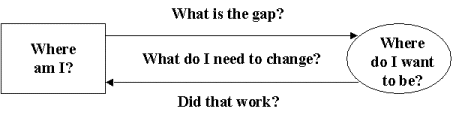
Some will recognize the language of IFL in these questions, and these types of questions certainly drive a lot of the IFL units taught, but think about how they can apply to other content areas as well. What would this look like in another classroom? How might they be modified to generally have a student check their own progress in another course? How could the teacher use the information from these questions in planning instruction?
Consider this cycle also:
While the lesson may change and the content varies, students can gain a lot of insight into their own work by being trained and taught ways to self-assess. One teacher in particular, Dan Zomack in the English department, is having success with his standard 9th graders by zeroing in on the following questions, which his students use frequently to self-assess their work:
Understanding the Assessment Task:
1. Looking back over the task, what will you need to do first, second, third, etc. to fully address the task in your response?
2. Who are you writing for, and how can you select and explain evidence from the text to suit the audience who will read this assessment?
StepBack After Completing the Task:
1. In ____ words or less, what did you include in your response that makes it complete, thoughtful, and accurate?
2. When faced with a difficult part of the task, what did you do to overcome the difficulty?
3. What more did you learn about the text by completing the assessment task?
Some will recognize the language of IFL in these questions, and these types of questions certainly drive a lot of the IFL units taught, but think about how they can apply to other content areas as well. What would this look like in another classroom? How might they be modified to generally have a student check their own progress in another course? How could the teacher use the information from these questions in planning instruction?
Consider this cycle also:
As teachers, we ask these questions of ourselves daily. We go through that cycle shown above also! Think about what this might look like for our students if we aren't already using some sort of self-assessing technique with our kids. There is a wealth of info to be gleaned. Thanks to Mr. Zomack for sharing his technique!
Wednesday, November 12, 2014
Essay Contest for Students!! Share the Word!
Our students in Chapel Hill-Carrboro City Schools have an excellent opportunity to win some recognition and some cash!! Here is some info for each of the contests to share with your students:
1. The 2014 Sallie Markham Michie Trust Essay Contest
This essay contest is open to students in grades 5-12 who reside in Orange County and the portion of Chatham County that lies north of Highway 64 and east of Highway 87 are eligible. Last year's winner received $4,500!! The prize amount varies by year, but students are certainly encouraged to take advantage of this local contest! Information on the process, the topics for high school students, and questions about the nature of the contest can be found here.
The deadline for entries is December 4th!!
2. The 2014-2015 Orange County Human Relations Month Student Essay Contest
6th-12 grade students living in Orange County are eligible for this contest, and students interested in taking part in this contest are asked to write essays that explore a topic of equality or social justice. Please check the Orange County Human Relations Commission's official flyer for the contest to learn about their official definition of social justice. Cash prizes are available for first, second, and third place at both the middle and high school levels. Also, winners will be asked to read their essays at the Pauli Murray Awards in February.
Mailed entries must be postmarked by Friday, December 12th, 2014 and electronic and hand-delivered by Tuesday, December 16th by 4PM.
3. Chapel Hill-Carrboro City Schools 2nd Annual All-High School Fiction and Poetry Contest
This contest is open to all CHCCS high school students, and cash prizes will be awarded to winners in both the fiction and the poetry categories. You could win up to $500 for first place! Judging for the contest will be done by local authors, and you'll have the chance to read your work aloud as well.
Contest submissions are due by March 13, 2015. If you have questions about this contest, ask Mrs. Smith in Room 186, Quad C or Mr. Winstead in Room 268, Quad C.
Read more about it here!
Thanks for spreading the word about these opportunities for our students!
1. The 2014 Sallie Markham Michie Trust Essay Contest
This essay contest is open to students in grades 5-12 who reside in Orange County and the portion of Chatham County that lies north of Highway 64 and east of Highway 87 are eligible. Last year's winner received $4,500!! The prize amount varies by year, but students are certainly encouraged to take advantage of this local contest! Information on the process, the topics for high school students, and questions about the nature of the contest can be found here.
The deadline for entries is December 4th!!
2. The 2014-2015 Orange County Human Relations Month Student Essay Contest
6th-12 grade students living in Orange County are eligible for this contest, and students interested in taking part in this contest are asked to write essays that explore a topic of equality or social justice. Please check the Orange County Human Relations Commission's official flyer for the contest to learn about their official definition of social justice. Cash prizes are available for first, second, and third place at both the middle and high school levels. Also, winners will be asked to read their essays at the Pauli Murray Awards in February.
Mailed entries must be postmarked by Friday, December 12th, 2014 and electronic and hand-delivered by Tuesday, December 16th by 4PM.
3. Chapel Hill-Carrboro City Schools 2nd Annual All-High School Fiction and Poetry Contest
This contest is open to all CHCCS high school students, and cash prizes will be awarded to winners in both the fiction and the poetry categories. You could win up to $500 for first place! Judging for the contest will be done by local authors, and you'll have the chance to read your work aloud as well.
Contest submissions are due by March 13, 2015. If you have questions about this contest, ask Mrs. Smith in Room 186, Quad C or Mr. Winstead in Room 268, Quad C.
Read more about it here!
Thanks for spreading the word about these opportunities for our students!
Monday, November 10, 2014
Frayer Model Follow-Up
It has been a little over a week since I discussed the Frayer Model with everyone. Yes, that handy tool that can be used to teach vocabulary is one of the more well-known strategies used for teaching new words, concepts, ideas to students, and that's because it's one of the most effective.
As a refresher, here is what the Frayer looks like:
I know you've been shown several strategies for teaching vocabulary over the past few weeks, and as always, choose the ones that best fit you, your students, and your instructional goals. As you remember from the presentation, Frayers are also super easy to make!
If you are using the Frayer in your classes, I would love to hear about how it is going, as well as any other vocabulary strategies you are using and how I can support you!
As a refresher, here is what the Frayer looks like:
I know you've been shown several strategies for teaching vocabulary over the past few weeks, and as always, choose the ones that best fit you, your students, and your instructional goals. As you remember from the presentation, Frayers are also super easy to make!
If you are using the Frayer in your classes, I would love to hear about how it is going, as well as any other vocabulary strategies you are using and how I can support you!
Wednesday, November 5, 2014
Paint Samples for Vocabulary..Where did That Originate?
It was interesting to see so many people curious about where the idea for using paint sample strips for vocabulary came from, so I thought I would share with you the video where I originally saw the idea:
As you can see, this English teacher uses it to not only teach academic vocabulary, but also to teach the different endings and parts of speech that words can employ. You also get to see the competitive aspect of having students use the words in action!
If this seems like a valuable idea, think about what it might look like in your subject area!
As you can see, this English teacher uses it to not only teach academic vocabulary, but also to teach the different endings and parts of speech that words can employ. You also get to see the competitive aspect of having students use the words in action!
If this seems like a valuable idea, think about what it might look like in your subject area!
Need help implementing a writing standard?
It's November!
Hopefully you are having success implementing the Common Core anchor standard in writing that you chose at the start of the year for your PDP.
If you need a reminder of the standards, here is a link to the Common Core writing standards. This will at least give you an idea as to how the standards link together and how the standards are arranged into different areas:
Hopefully you are having success implementing the Common Core anchor standard in writing that you chose at the start of the year for your PDP.
If you need a reminder of the standards, here is a link to the Common Core writing standards. This will at least give you an idea as to how the standards link together and how the standards are arranged into different areas:
- Text types and purposes
- Production and distribution of writing
- Research to build and present knowledge
- Range of writing
Remember, there are Power Point presentations available via Google Drive that I shared out earlier in the year, breaking down each standard and what it looks like at the high school level. There are also some suggested activities in each presentation that you may find useful, too. If you need a reminder as to where those are, don't hesitate to ask for assistance!
I christen this literacy blog, The Pawprint!
Hello East Chapel Hill High staff and faculty!
I'm very excited to roll out what I hope will be a valuable resource for you here at East, The Pawpint. This is a blog dedicated to sharing resources, strategies, videos, and much more, all centered around literacy instruction, specifically reading, writing, and vocabulary. My plan is to post at least twice a week, so as to better share out things that I come across that may help you in your instruction, share news, spotlight YOU and all the work you are doing in your classes, and much more.
I hope that you will also pass along any resources, strategies, and/or successes that you have with any of the aforementioned areas of instruction. Sharing and supporting each other as we work to build student success in all aspects of literacy is key, and it is my hope that this space becomes a place to showcase solid instructional strategies and the work that we all do.
If you have any tips or advice on how to make this blog better (it's my first one, so feel free to offer insight!) please pass those along.
Happy reading!
Nick
I'm very excited to roll out what I hope will be a valuable resource for you here at East, The Pawpint. This is a blog dedicated to sharing resources, strategies, videos, and much more, all centered around literacy instruction, specifically reading, writing, and vocabulary. My plan is to post at least twice a week, so as to better share out things that I come across that may help you in your instruction, share news, spotlight YOU and all the work you are doing in your classes, and much more.
I hope that you will also pass along any resources, strategies, and/or successes that you have with any of the aforementioned areas of instruction. Sharing and supporting each other as we work to build student success in all aspects of literacy is key, and it is my hope that this space becomes a place to showcase solid instructional strategies and the work that we all do.
If you have any tips or advice on how to make this blog better (it's my first one, so feel free to offer insight!) please pass those along.
Happy reading!
Nick
Subscribe to:
Posts (Atom)